 Add Row
  Add
Add 

Did you know the average email open rate across industries just dipped below 22%? If your email open rates are dropping, you’re not alone—but you don’t have to settle for lackluster results. In this comprehensive guide, you’ll uncover why open rates matter, what drives their decline, and how a simple subject line tweak can spark a sharp turnaround in every email marketing campaign . Whether you’re a seasoned marketer or just starting out, these actionable tips will help reignite engagement and transform your email marketing performance fast.
Email Open Rates: The Startling Reality & Why You Can't Ignore Declining Open Rates
- Recent studies show the average email open rate across industries has slipped below 22%.
- This section will reveal the latest marketing benchmarks and highlight why understanding your email open rates can make or break your email marketing strategy.
The odds are, if you don’t track your email open rates , you might be leaving money on the table. According to the latest email marketing benchmarks , even well-crafted email campaigns are opening to smaller audiences than ever before. The reasons are complex—shifting algorithms, inbox overload, changing behaviors, and new privacy protections all intersect to drive down visibility. For businesses that rely on mail marketing to nurture leads or drive sales, these trends present an urgent challenge. If you ignore low open rates , you risk missing out on conversion opportunities and watching your marketing benchmarks deteriorate.
The critical takeaway? Email open rate is the first signal that your audience is paying attention. When this metric drops, it often signals deeper problems—like uninspiring subject lines, poor targeting, or technical deliverability issues. Start by always benchmarking your own mail open rate against current industry averages. Any sustained decrease should trigger immediate investigation and action; otherwise, your carefully crafted email content might stay forever unread. Simply put, gaining a handle on your email open rates is non-negotiable for a healthy marketing strategy in 2025.

Understanding Email Open Rates: Definitions, Metrics, and Industry Benchmarks
What Are Email Open Rates and How Are They Calculated?
- Definition of email open rate, calculation formula, and an explanation of unique vs. total open rates.
Email open rates measure how many recipients actually opened your email campaign out of the total number delivered. To calculate an open rate , divide the total number of unique opens by the number of delivered emails, then multiply by 100. The formula looks like this: (Unique Opens ÷ Emails Delivered) x 100 = Open Rate (%) . But there are nuances. Unique open rates only count each recipient once, even if they open the email multiple times; total open rates count each open, regardless of how many times the same user revisits your message.
Why does this matter? Unique opens provide a more accurate snapshot of real engagement, while total opens can indicate deeper interest or content sharing. It’s important to track both, but most email marketing platforms report on unique opens to avoid inflated metrics. Regardless, any measure of email open rate gives crucial insight into the initial impact of your messaging—and sets the tone for the rest of your marketing campaign .
Industry Benchmarks: What Is an Average Email Open Rate in Different Sectors?
- Data-driven comparison table of email open rates by industry: revealing the current marketing benchmarks and email marketing benchmarks for 2025 (Table included).
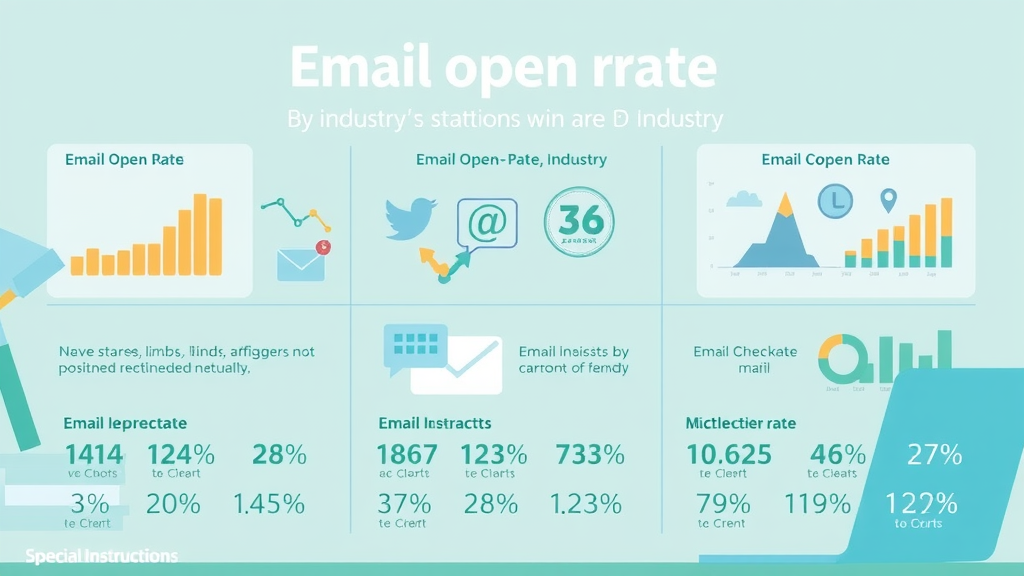
Knowing the average email open rate in your sector helps you gauge whether you’re leading or lagging behind peers. The 2025 email marketing benchmarks vary by industry, influenced by audience expectations, message frequency, and subject matter. For example, the technology sector might average a 19% open rate , while nonprofits often see 25% or higher. By benchmarking, you’ll identify when your results signal a performance gap—or set you apart as a leader. Regularly reviewing industry marketing benchmarks ensures your email marketing campaign is always informed by data, not just gut feeling.
| Industry | Average Email Open Rate | Mail Open Rate | Source (Q1 2025) |
|---|---|---|---|
| Retail | 21.1% | 20.8% | Marketing Benchmarks 2025 |
| Finance | 22.5% | 22.1% | Email Marketing Benchmarks |
| Nonprofit | 25.3% | 24.7% | Mail Marketing Report Q1 |
| Technology | 19.2% | 19.0% | Marketing Benchmark Digest |
| Healthcare | 21.8% | 21.5% | Industry Average Audit |
Why Email Open Rates Matter for Every Email Marketing Campaign
- Explore why open rates are the gateway metric for successful email marketing and mail marketing. Discuss how open rates directly correlate to ROI, lead nurturing, and engagement for every email campaign.
Email open rates are more than just a vanity metric—they serve as the gateway for all your campaign outcomes. If few recipients open your email, the greatest email content and best-designed layout won’t move the needle. High open rates mean your subject lines , timing, and sender reputation are working together to pique subscribers’ curiosity and maintain their trust. This metric has a ripple effect: when open rates climb, so do click-throughs, conversions, and ultimately your ROI from mail marketing .
Effective lead nurturing depends on consistently strong email open rates . Each open signals an opportunity for relationship-building, product consideration, or direct sales. In contrast, plummeting open rates can quickly sabotage your email marketing benchmarks . That’s why your entire marketing campaign —from subscriber segmentation to email subject line testing—should be consciously designed to drive better opens and ongoing engagement. In 2025, tracking and improving this one number can genuinely make or break your overall digital marketing performance.
The Hidden Causes Behind Falling Email Open Rates
Key Factors Impacting Your Email Open Rate
- Deliverability, sender reputation, list quality, timing, email content, and subject lines all impact email open rates.
Behind every dip in email open rates lies a web of interconnected issues. The first is deliverability : if your emails aren’t reaching inboxes, opens naturally fall. Factors like sender reputation, spam complaints, and authentication settings (such as SPF and DKIM) all affect whether your emails get through or end up in the spam folder. Next, consider your email list quality. Outdated or disengaged subscribers are less likely to open, dragging down your average open rate and inflating your bounce rates.
Timely delivery is another underappreciated lever. Sending at odd hours or too frequently can overwhelm readers, making them tune out your messages. The magic, however, often lies in your subject line and first impressions. If your email subject fails to intrigue or hint at value, even the most loyal recipient might scroll past. High-performing mail open rates generally reflect a perfect storm of quality content, list management, optimized timing, and continuous subject line testing.
"The most successful marketing campaigns obsess not over send quantity, but open quality — every open is a relationship opportunity."

How Modern Spam Filters and Privacy Updates Affect Open Rates
- Analysis of Apple Mail Privacy Protection, Gmail tabs, and new privacy tech on accurate email open rate tracking.
Today’s email open rates are also shaped by rapidly evolving technology. Apple’s Mail Privacy Protection (MPP) now preloads images to shield user data, leading to inflated open statistics and making it harder for marketers to gauge true subscriber engagement. Meanwhile, Gmail’s inbox tabs automatically sort messages—many mail marketing campaigns get tucked into “Promotions,” where they're easily overlooked. New privacy laws and spam-filtering AI add further complexity; authentication is required, but so is a razor-sharp focus on message relevance.
These updates don’t just influence your reported open rate —they also redefine how you interpret success. That’s why savvy marketers combine open rates with deeper engagement signals, like click-through and conversion rates, to form a holistic understanding of performance. By recognizing and adapting to these realities, you can recalibrate your marketing campaign and keep building authentic recipient relationships in a privacy-first world.
Diagnosing Your Email Open Rates: Step-by-Step Audit
- A practical, actionable process to review email campaigns and isolate issues contributing to suboptimal open rates.
Tackling falling email open rates starts with a structured review of what’s working—and what’s not. Conducting a data-driven audit helps pinpoint the roadblocks to high open rates and sets the stage for improvement. Here’s a practical checklist:
- Review recent email campaign analytics.
- Segment your email list to identify underperforming groups.
- Analyze historical open rate trends to spot patterns or drops.
- Test your emails across devices for display or deliverability issues.
- Compare your metrics against industry marketing benchmarks.
Each of these steps uncovers crucial insights. Are some list segments less engaged than others? Do certain days or times consistently yield low open rates ? Is your sender reputation negatively impacting deliverability? By evaluating both quantitative data ( open rate , bounce rate) and qualitative cues (subject lines, preview text), you’ll develop a targeted recovery plan to boost your mail open rate and reclaim inbox attention.

The Simple Fix: How a Subject Line Makeover Can Instantly Increase Email Open Rates
Subject Line Optimization: Proven Techniques That Work
- Personalization, curiosity gaps, urgency, numbers, emoji use, and length best practices with real-world examples. Embed main keyword and marketing best practices throughout.
If there’s one lever you can pull for rapid results, it’s the subject line . Studies show that tweaking this single element can swing your email open rates upward overnight. Leading strategies include personalization—using your recipient's name or referencing past behavior makes your message feel uniquely relevant. Building curiosity gaps (“You missed this in your last report”) and a sense of urgency (“Last chance: 24-hour exclusive offer!”) consistently outperform generic headlines. Adding numbers (“3 Secrets Behind Top 2025 Marketers”) and tasteful emojis can also increase the likelihood your email stands out in a crowded inbox.
Optimal subject line length matters too: between 6–10 words is the current sweet spot for maximum impact. A/B testing real-world examples will reveal which formats resonate most with your own audience. Remember: a thoughtful, creative subject line is often the deciding factor between a swift open and a one-way trip to the trash folder—so make every character count.

A/B Testing Subject Lines for Higher Open Rates
- Practical guide for running multivariate subject line tests and analyzing results.
Don’t just rely on guesses—use A/B testing to determine which subject lines actually move the needle for your mail open rate . This means splitting your email list and sending each half a different variation of your subject line. Over a statistically meaningful sample, monitor which version leads to a higher open rate . Expand on this by testing variables like personalization, tone, or inclusion of offers versus information.
Multivariate experiments, which test multiple elements simultaneously (like subject lines and preview text), can further illuminate what your audience responds to best. After each campaign, examine the numbers closely: which version won, by what margin, and why? True optimization is an ongoing process, so keep your tracking tight and your creative ideas flowing.
"Your email subject line is your first (and often only) chance to earn the open. Make it count." – Email Marketing Expert
Boosting Your Mail Open Rate: Additional Strategies Beyond Subject Lines
Segment Your Email List for Personalized Email Open Rates
- How segmentation drives higher open rates and increases overall marketing benchmarks for email campaigns.
Segmentation is a force multiplier for email open rates . By dividing your email list into targeted groups—such as new leads, returning customers, or lapsed subscribers—you can deliver relevant content that resonates with each audience. Segmented campaigns routinely outperform generic blasts, often generating open rates 15% higher than non-segmented sends. Knowing your audience’s preferences, pain points, or purchase cycles lets you speak directly to their interests, improving both engagement and your marketing benchmarks .
List segmentation can be driven by demographic data, behavior (such as recent purchases or website visits), or engagement history (like past open rates or clicks). This level of personalization not only lifts your immediate mail open rate but increases loyalty and retention in your overall email marketing campaigns .

Optimize Send Times and Cadence for Maximum Open Rates
- Practical guidance on the best days and times to send based on current email marketing benchmarks.
Even the best-crafted messages will struggle if they arrive at the wrong time. According to recent email marketing benchmarks , mid-week mornings (especially Tuesdays and Wednesdays, between 8 a.m. and 11 a.m.) typically yield the highest email open rates . However, your unique audience may respond best at different times—track and test for your list.
Frequency also matters. Sending too often can prompt unsubscribes, while too little leads to low brand recall and low open rates . Establish a cadence that maintains relevance without overwhelming your email list , and always check metrics to refine your timing strategy for each new marketing campaign .
Improve Sender Name and Reputation to Lift Email Open Rate
- Best practices for from-name formatting, sender authentication (SPF, DKIM), and maintaining a positive reputation.
Subscribers judge your emails at a glance, and a trustworthy sender name can increase mail open rate dramatically. Use a familiar, recognizable sender name (like “[Brand] Team” or a real person at your company) to reassure recipients. Authenticate your domain by setting up SPF and DKIM records; this supports inbox placement and shields your email campaigns from phishing or spoofing attacks that damage sender reputation.
Regularly “clean” your email list to remove inactive subscribers, keep complaint rates low, and build an identity as a legitimate sender. Combined, these technical and reputational efforts build long-term gains in email open rates .
Enhance Email Content Previews to Encourage More Opens
- How preview text can support your subject line and increase mail open rates.
The preview text, or preheader, appears next to your subject line and can double your message’s impact. Many recipients decide whether to open based on this extra snippet. Make your preview a continuation or “teaser” that builds on your subject line , adding information, urgency, or intrigue.
Use the preview wisely by front-loading the value proposition and avoiding generic filler (“Can’t read this email? Click here.”). A carefully crafted preheader, combined with a compelling subject line , may be the final nudge recipients need to raise your mail open rate —especially on mobile, where space is at a premium.

Monitoring and Measuring Email Open Rates for Long-term Success
Tracking Tools for Email Open Rate Performance
- Overview of analytics platforms and ESP tools to monitor open rates and average open rate by campaign.
Accurate tracking is foundational for improving email open rates over time. Leading email service providers (ESPs) —like Mailchimp, HubSpot, and ActiveCampaign—make it easy to access open rates by campaign, segment, and even device. Dedicated analytics dashboards let you spot trends, anomalies, and successful patterns at a glance. These tools often integrate with advanced marketing platforms, allowing you to layer open rate data with clicks, conversions, and revenue attribution for smarter, more holistic decision-making.
Set up regular reporting to flag dips in average open rate or highlight stand-out performers, making it easier to double down on what works. An automated reporting cadence helps keep your entire marketing strategy nimble and responsive as benchmarks shift.
Key Metrics to Watch Alongside Email Open Rates
- CTR, conversions, unsubscribe rate, list growth, and spam complaints and their interaction with open rates.
While open rates are a critical first filter, they’re not the whole story. Monitor related performance indicators like click-through rate (CTR) , conversion rate, and list growth for a fuller picture of campaign health. Rising open rates paired with strong CTRs signal that not only are your emails grabbing attention—they’re prompting meaningful action.
Keep an eye on unsubscribes and spam complaint rates; sharp rises could indicate irrelevant content, high frequency, or list fatigue, all of which suppress future mail open rate . Combining these metrics lets you diagnose problems quickly, set realistic marketing benchmarks , and optimize every stage of your email marketing campaign for sustainable, compounding results.
Case Studies: Before-and-After Results Using These Email Open Rate Fixes
- Real-world examples showing dramatic improvement in mail open rate after applying subject line and content tweaks.
Nothing proves the value of optimization like concrete before-and-after results. Brands across industries have rescued stagnant open rates by revamping their subject lines, segmenting lists, or updating their sender labeling practices. Below you’ll find several recent case studies demonstrating just how dramatically these simple fixes can improve engagement, sometimes in a matter of days:
| Campaign | Previous Open Rate | After Fix Open Rate | Key Changes |
|---|---|---|---|
| Tech SaaS Onboarding | 14% | 23% | Personalized subject lines, preheader optimization |
| Retail Holiday Blast | 18.7% | 26.5% | Segmented sends by past purchase, new sender name |
| Nonprofit Awareness Drive | 21.2% | 28.9% | Urgent call-to-action, emoji in subject line |
People Also Ask: Expert Answers on Email Open Rates
What is a good open rate for email?
- A good email open rate varies by industry, but a 20-30% open rate is generally considered healthy according to the latest marketing benchmarks and email marketing benchmarks.
Is 50% a good email open rate?
- A 50% open rate is excellent and well above industry averages, indicating highly targeted, engaging campaigns and exceptional subject line performance.
Is 30% a good open rate?
- Yes, a 30% open rate puts your campaigns among the top performers compared to average email open rates.
What is the industry standard email open rate in 2025?
- Industry research sets the 2025 benchmark between 19% and 24%; however, this varies based on market and mail marketing approach.
Frequently Asked Questions About Email Open Rates
- How often should you check your email open rates? Regularly—at least weekly—to spot sudden drops or trends and adapt campaigns swiftly.
- Can emojis boost open rates? Yes, tasteful emoji use in subject lines can increase visibility and engagement, especially on mobile devices.
- What common mistakes lower email open rates? Generic subject lines, poor list segmentation, sending without permission, and neglecting sender reputation are key culprits.
- How does mobile usage impact open rates? With over half of emails now read on mobile, mobile-friendly designs and concise subject lines are crucial for maximizing opens.
- Are purchased email lists damaging to open rates? Definitely—purchased lists often contain unengaged users and spam traps, leading to poor deliverability and lower open rates.

Next Steps: Apply These Simple Fixes to Raise Your Email Open Rate Today
- Audit your recent email campaigns for open rate trends
- Revamp subject lines using high-performing templates
- Personalize sender information
- Segment your email list
- Measure results and set new marketing benchmarks for future campaigns
"Great marketers track their email open rates daily — successful marketers adapt instantly when the numbers drop."
Looking for Expert Guidance on Email Open Rates?
- Ready to grow your business? Book your free marketing strategy with our team today
Don’t wait—start auditing and optimizing your email open rates now. Take action, use proven strategies, and watch your email marketing benchmarks soar.
To further enhance your understanding of email open rates and strategies to improve them, consider exploring the following resources:
-
“What are good open rates, CTRs, & CTORs for email campaigns?” ( campaignmonitor.com )
-
“How to Increase Email Open Rates — 10 Tips for 2025” ( omnisend.com )
These articles provide valuable insights into industry benchmarks and practical tips to boost your email marketing performance.




Write A Comment